Tunneling Overview: Modern Methods and Key Technologies
Tunneling overview covers the essential methods, technologies, and industry trends shaping underground construction today, from conventional drill-and-blast to advanced mechanised systems and digital integration.
Table of Contents
- 1. Core Tunneling Methods and When They Are Used
- 2. Digital Technologies Reshaping the Tunneling Overview
- 3. Ground Support and Stabilisation in Modern Tunneling
- 4. Safety, Risk Management and Workforce Trends
- FAQ
- Comparison of Tunneling Methods
- Practical Tips for Tunneling Projects
- Final Thoughts on Tunneling Overview
- Useful Resources
Tunneling overview is the study of methods, equipment, and digital tools used to excavate underground passages for transport, utilities, and mining. This article examines core techniques, emerging technologies like AI and digital twins, ground stabilisation with grouting, and safety trends driving the industry forward.
- India completed 60 tunnels totalling 100 kilometres between June 2024 and May 2025 (India Infrastructure Research, 2025)[1]
- India's tunnel development pipeline includes 1,870 tunnels with a combined length of 3,010 kilometres (India Infrastructure Research, 2025)[1]
- Digital technology adoption, including BIM, AI, and drones, is increasing across Indian tunneling projects (India Infrastructure Research, 2025)[1]
A tunneling overview starts with understanding why tunnels matter. They move people, water, power, and data beneath congested cities and through mountains that would otherwise block transport routes. The global tunneling sector is expanding rapidly, driven by urbanisation and infrastructure renewal. Engineers now combine century-old excavation principles with real-time data analytics, autonomous machinery, and advanced materials. This article provides a clear tunneling overview covering core methods, digital transformation, ground support systems, and safety practices that define modern underground construction.
1. Core Tunneling Methods and When They Are Used
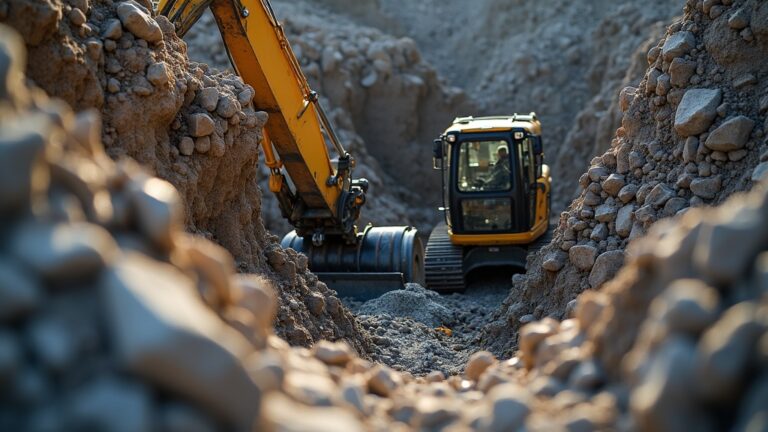
Every tunneling overview must start with the two primary excavation families: drill-and-blast and mechanised tunneling. Drill-and-blast remains the go-to method for hard rock in remote or mountainous terrain. Workers drill a pattern of holes into the rock face, pack them with explosives, and blast the material in controlled rounds. The method is flexible, relatively low-cost for short tunnels, and can handle variable geology. However, it is slower, creates vibration, and requires careful ventilation to clear fumes and dust.
Mechanised tunneling uses Tunnel Boring Machines (TBMs) that cut through soil and rock with a rotating cutterhead. TBMs excel in soft ground and urban environments where surface settlement must be minimised. They install precast concrete segmental lining as they advance, providing immediate ground support. Modern TBMs can handle mixed-face conditions, switching between open and closed modes. The choice between drill-and-blast and TBM depends on tunnel length, geology, budget, and schedule. A third method, the New Austrian Tunneling Method (NATM), uses sprayed concrete and rock bolts to mobilise the ground's own strength. NATM is common for road and rail tunnels in varied geology where flexibility is needed.
For shorter crossings and utility tunnels, techniques like pipe jacking and microtunneling allow trenchless installation. These methods push prefabricated pipes through the ground using hydraulic jacks, with minimal surface disruption. They are ideal for water mains, sewer lines, and cable conduits under roads and railways. Each method has specific equipment requirements, and the choice directly affects project cost, duration, and risk profile.
2. Digital Technologies Reshaping the Tunneling Overview
Digital tools are transforming how tunnels are designed, monitored, and maintained. The UK Government's ‘Future of Tunnelling’ review notes that “emerging hardware and software technology is improving our ability to investigate the natural and man-made subsurface, such as multi-sensing remote investigation techniques mapping the ground assisted by AI” (Department for Transport & Geotechnical Engineering Experts, 2024)[2]. This shift from site-based human inspection to remote sensing improves data quality and worker safety.
Building Information Modelling (BIM) creates a digital representation of the tunnel and its surrounding ground. Engineers use BIM to detect clashes between structural elements, services, and geology before construction starts. Digital twins extend BIM by linking the model to live sensor data from the tunnel. Strain gauges, settlement monitors, and groundwater sensors feed back into the twin, allowing real-time comparison between as-built conditions and the design intent. When deviations appear, teams can adjust excavation or support before problems escalate.
Artificial intelligence (AI) and machine learning are entering the tunneling overview as powerful analytical tools. AI systems analyse TBM performance data to predict cutterhead wear, advance rate, and ground conditions ahead of the face. The same UK Government review states that “the increase in cloud computing, compute power and graphical processing unit (GPU) is enabling complex tunnel design and real-time smart sensor data streams to be integrated into design and monitoring” (Future of Tunnelling report team, 2024)[2]. For professionals seeking to upskill, artificial intelligence training near me can provide practical knowledge of these emerging tools. Additionally, AI training GPU resources help engineers understand the hardware requirements for running complex models on site.
Data sharing initiatives are also gaining traction. Cross-industry collaboration on platforms like the National Underground Asset Register (NUAR) in the UK enables more effective information management for buried utilities and tunnel routing constraints (Future of Tunnelling report team, 2024)[2]. When multiple organisations share ground investigation data, the whole industry benefits from reduced uncertainty and lower project risk.
3. Ground Support and Stabilisation in Modern Tunneling
Safe tunneling depends on reliable ground support. The tunneling overview of stabilisation techniques includes rock bolts, shotcrete, steel arches, and grouting. Rock bolts tension the ground mass, preventing blocks from falling into the excavation. Shotcrete, a sprayed concrete mix, seals exposed surfaces and provides immediate structural support. Steel arches are used in weak ground or high-stress zones to carry load until the final lining is installed.
Grouting plays a critical role in controlling groundwater and improving ground strength. Permeation grouting fills voids in soil or rock with a low-viscosity grout, reducing permeability without displacing the ground. Jet grouting uses high-pressure jets to erode and mix soil with cementitious grout, creating columns of improved ground. In mechanised tunneling, tail void grouting fills the annular gap between the TBM shield and the segmental lining, preventing settlement and ensuring load transfer. Colloidal grout mixing equipment for mining and tunneling is essential for producing stable, homogeneous grout suspensions that perform consistently under high-pressure injection.
Ground freezing is another stabilisation method used in water-bearing soils or when access is restricted. Freeze pipes circulate chilled brine or liquid nitrogen, creating a frozen soil barrier that acts as both structural support and water cutoff. The choice of stabilisation method depends on ground conditions, tunnel depth, and proximity to existing structures. A well-designed ground support system reduces construction risk and extends the tunnel's service life.
4. Safety, Risk Management and Workforce Trends
Tunneling carries inherent risks: ground collapse, flooding, fire, and exposure to hazardous gases. Modern safety management relies on systematic risk assessment, real-time monitoring, and robust emergency plans. The UK Government review highlights that “technology acquiring information remotely is enabling construction processes, operation and maintenance to reduce from site-based human involvement, offering benefits in quality of data, improving health and safety, and an opportunity to reduce the size of tunnels if human access is not required” (UK Government Future of Tunnelling authors, 2024)[2]. Remote-controlled TBMs and automated mucking systems keep workers away from the most hazardous zones.
Gas monitoring systems continuously sample air quality in the tunnel, detecting methane, hydrogen sulphide, and carbon monoxide. Ventilation must be designed to dilute and remove contaminants, with backup systems for emergency scenarios. Fire safety includes flame-retardant materials, fire-resistant conveyors, and refuge chambers where workers can shelter during an evacuation.
The workforce itself is changing. Digital skills are increasingly important; tunnel engineers now need familiarity with BIM software, data analytics, and sensor integration. The industry faces a skills gap as experienced professionals retire. Training programmes that combine traditional geotechnical knowledge with digital literacy are essential. Cross-industry collaboration on data sharing and standardised training frameworks can help attract new talent and retain experienced workers.
Important Questions About Tunneling Overview
What is the difference between a TBM and drill-and-blast tunneling?
How is AI used in tunneling projects?
What is the role of grouting in tunneling?
How long does it take to build a tunnel?
Comparison of Tunneling Methods
Selecting the right tunneling method is one of the most critical decisions in any underground project. The table below compares the four main approaches based on key parameters.
| Method | Best Ground Type | Typical Advance Rate | Surface Impact |
|---|---|---|---|
| Drill-and-Blast | Hard rock | 2–5 m/day | Vibration, noise |
| TBM (Earth Pressure Balance) | Soft ground, mixed face | 10–20 m/day | Minimal settlement |
| NATM (Sprayed Concrete) | Variable geology | 3–8 m/day | Low if controlled |
| Pipe Jacking / Microtunneling | Soil, soft rock | 5–15 m/day | Very low (trenchless) |
Practical Tips for Tunneling Projects
Success in tunneling requires careful planning and execution. Here are actionable tips based on current industry best practices.
- Invest in ground investigation early. Inadequate site investigation is the most common cause of cost overruns and delays. Use multiple investigation methods, including boreholes, geophysical surveys, and in-situ testing. The data feeds directly into method selection and risk assessment.
- Adopt digital twins from the design phase. A digital twin is not just for operations. Link the design model to real-time monitoring data during construction. This allows early detection of deviations and supports informed decision-making when ground conditions change.
- Choose grouting equipment carefully. The quality of grout suspension directly affects permeation, jetting, and tail void filling. Colloidal mixers produce stable, homogeneous grout that performs reliably under pressure. Ensure the mixing plant matches the project's production rate and space constraints.
- Plan for workforce digital upskilling. As AI and data analytics become standard, tunnel engineers need training in these tools. Partner with training providers that offer practical, project-focused courses on digital technologies for underground construction.
Final Thoughts on Tunneling Overview
This tunneling overview has covered the essential methods, digital innovations, ground support systems, and safety practices that define modern underground construction. The industry is moving toward greater automation, data-driven decision-making, and collaborative information sharing. Engineers who embrace these changes will deliver safer, more efficient, and more predictable projects. For a deeper look at how grouting technology supports tunnel stabilisation, explore grout mixing solutions for mining and tunneling.
Useful Resources
- Expanding connectivity: trends and developments in the tunnelling sector. India Infrastructure Research (Indian Infrastructure).
https://indianinfrastructure.com/2025/07/07/expanding-connectivity-trends-and-developments-in-the-tunnelling-sector/ - Future of tunnelling: high level review of emerging technologies (Annex to Future of the Subsurface report). UK Government.
https://www.gov.uk/government/publications/future-of-the-subsurface-report/future-of-tunnelling-high-level-review-of-emerging-technologies-annex - Shaping the future of tunneling with data and emerging technologies. Cambridge University Press.
https://www.cambridge.org/core/services/aop-cambridge-core/content/view/C3048E309762F63DADC9B36A7B18D170/S2632673623000242a.pdf/shaping_the_future_of_tunneling_with_data_and_emerging_technologies.pdf